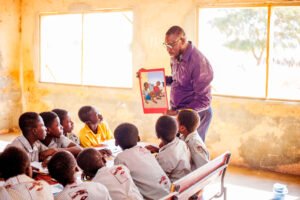

Parent-Teacher Associations (PTAs) in Ghana play an important role in supporting basic education and strengthening school communities. Across public basic schools, PTAs bring together parents and teachers to contribute to the learning environment, pupil welfare, and overall school development.
While they are often associated with meetings or financial contributions, their role within Ghana’s education system is broader and more structural.
What Are PTAs in Ghana and How Do They Function?
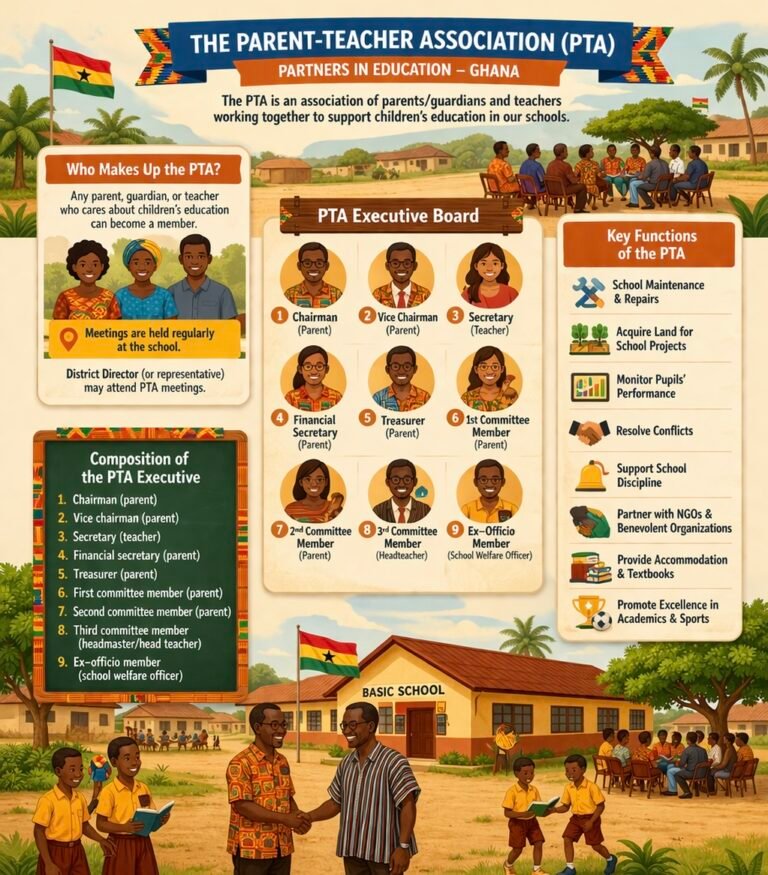
A PTA is a formal group within a school made up of parents or guardians and teaching staff. In many public basic schools, see Parent-Teacher Association composition and roles in Ghana PTAs operate alongside School Management Committees (SMCs), with a stronger emphasis on parental participation and community engagement.
They typically meet periodically to discuss school needs, pupil welfare, and ways the community can contribute to improving the learning environment. In this way, PTAs act as a bridge between the home and the classroom.
PTAs Within Ghana’s Education Policy Context
Community participation in education is embedded in Ghana’s national framework.
Under the Free Compulsory Universal Basic Education (FCUBE) policy, basic education is both a right and a shared responsibility. While the government provides funding, infrastructure, and oversight, communities are expected to play an active role in supporting schools.
PTAs are one of the primary structures through which this participation takes place. They provide a formal channel for families to contribute to school development and remain engaged with how schools are functioning.
The Role of PTAs in Supporting Schools in Ghana
Across Ghana, PTAs contribute to schools in ways that are often visible in the day to day experiences of pupils.
This support can include:
- Improving school infrastructure
Mobilising resources to repair classrooms, provide furniture, or improve sanitation facilities where gaps exist. - Providing teaching and learning materials
Supporting access to textbooks, exercise books, and supplementary resources. - Supporting school activities and participation
Contributing to events, extracurricular programmes, and initiatives that encourage attendance and engagement. - Encouraging accountability and communication
Creating space for discussions around pupil progress, attendance, and challenges affecting learning.
Strengthening the Link Between Home and School
One of the less visible but equally important roles of PTAs is strengthening the relationship between families and schools.
When parents are engaged in school discussions, they are better positioned to support their children’s learning at home. At the same time, teachers gain a clearer understanding of the contexts their pupils come from.
This connection helps create a more consistent learning experience, where expectations and support are aligned both in school and at home.
How This Connects to Practice
In school based work, this relationship between communities and schools is often where progress becomes more sustainable.
At Homeland Ghana Foundation, activities are designed to work alongside schools and the communities around them. This includes PTA meetings which are held on a termly basis and also ensuring that a team member attends each meeting, particularly one who works closely with the children through our workshops. Their presence allows us to gain deeper insights into the discussions and actively contribute by sharing what we, as an organisation, are doing to support the children as part of ongoing conversations about what schools need and how those needs can be addressed in practical ways. Learn about our work here.
For example, in some school engagements, discussions with PTAs help identify gaps in learning materials or infrastructure, which are then addressed through targeted, school based support. In 2019, when the homeland Ghana Team started attending PTA meetings, we discovered a decrease in the girls’ attendance and instances of non-enrolment in one of the schools in the Builsa North. This insight prompted the team to be more consistent in implementing our sanitary pad distribution project as menstrual stigma was noted as one of the reasons for the decrease in attendance. More about this approach can be found in our work on school activities and community engagement and education reports and insights.
This outlook recognises that improvements in basic education are most effective when they are shaped with the involvement of those closest to the school environment.
Context Matters
The effectiveness of PTAs in Ghana is not uniform across all schools. In some communities, they are highly active and well organised. In others, participation may be lower due to time constraints, economic pressures, or limited awareness of their role.
Public discussions sometimes reduce PTAs to conversations about financial contributions. While funding can be part of their work, it is only one aspect of a broader function centred on collaboration, participation, and shared responsibility.
Why PTAs in Ghana Remain Important for Basic Education
As Ghana continues to strengthen its basic education system, community involvement remains an important part of how schools function.
PTAs in Ghana represent one of the most direct ways communities stay connected to education. They create space for collective problem-solving and ensure that schools are not operating in isolation from the families they serve.
In practice, improving basic education in Ghana is not only the responsibility of schools or policymakers. It is shaped through everyday interactions between parents, teachers, and communities.